Virtual Schooling vs Traditional School: What’s Better for Your Child?
As parents, we naturally want the best for our children — not just academic excellence, but also physical health, emotional stability, and strong social skills. A child with exceptional intellectual ability but poor physical well-being may struggle in the long run. Likewise, strong physical health without proper academic development can limit future opportunities. The key lies in balance.
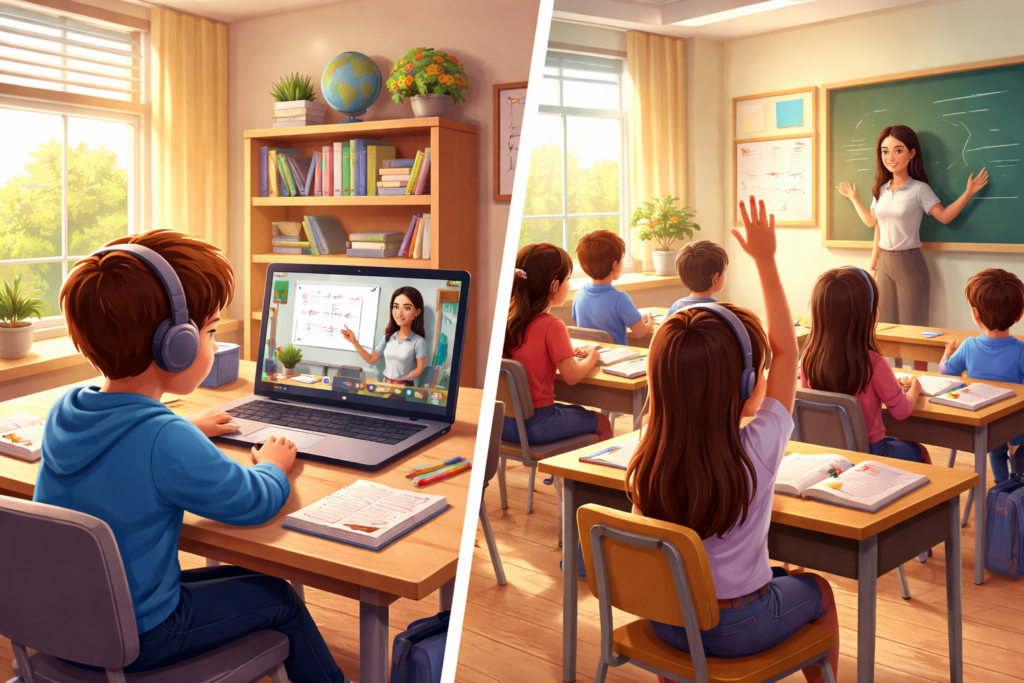
In today’s technology-driven world, virtual schooling has gained significant attention for its flexibility, accessibility, and personalized learning opportunities. At the same time, traditional classroom education continues to offer structured environments, peer interaction, and hands-on experiences that are difficult to replicate online.
So, which option truly supports your child’s overall development?
In this article, we will compare Virtual Schooling vs Traditional School, explore their impact on academic performance, social growth, and mental well-being, and help you make an informed decision that aligns with your child’s unique needs.
The Story of Virtual Schooling.
Virtual schooling has actually been around for a few decades. It started in the 1990s with programs like Virtual High School, which allowed students to take courses entirely online. In 1997, Florida Virtual School became the first statewide online public school. While accredited programs grew steadily through the 2000s, it was the COVID-19 pandemic that brought virtual learning into millions of homes worldwide almost overnight.
What is Virtual Schooling?
Simply put, virtual schooling (or online learning) is when children attend school via the internet instead of a physical classroom. Lessons, assignments, and tests are delivered through video classes, interactive apps, and digital resources.
In this model:
- Students can learn at their own pace and often tailor their studies to their specific interests.
- Teachers guide and assess students remotely.
- Parents often act as “learning coaches,” helping to structure the day and the home learning space.
Virtual schooling can be full-time, covering all subjects online, or supplemental, supporting traditional classroom learning. Its flexibility and accessibility are why so many families are embracing it as a lifestyle choice today.
Pros of Virtual Schooling for Children
Custom-Fit Learning:
Every child’s brain works differently. In a virtual setup, the “fast-forward” and “pause” buttons are real. Your child can fly through what they know and take a deep breath on the tricky stuff without feeling “behind.”
The Gift of Time:
Picture a morning without the frantic “shoes on, teeth brushed, out the door!” rush. Virtual schooling gives back those precious hours for a slow breakfast, extra sleep, or simply a more relaxed start to the day.
Custom-Fit Learning:
Every child learns differently. In a virtual setup, the “pause” button is real. Kids can breeze through what they already know and take their time with challenging topics — all without feeling pressured to keep pace with thirty other students.
A Sanctuary for the Senses:
For children who find loud hallways and bright fluorescent lights overwhelming, learning from home can be a safe haven. In a calm, familiar environment, their nervous system stays relaxed, helping them focus better.
Cost-Saving Opportunity
Virtual schooling offers meaningful cost-saving opportunities for families. With fewer expenses related to travel, uniforms, and daily logistics, parents can reduce overall education-related spending. These savings can be redirected toward quality learning resources, skill-based courses, or extracurricular interests that support a child’s growth.
Better Time Management
Virtual schooling helps children build practical time-management skills early on. With flexible schedules and clear learning goals, children learn to plan their day, manage study time independently, and balance learning with rest and personal interests. Over time, this fosters self-discipline and a stronger sense of responsibility.
“When online learning is well‑designed, it can be as good or even better than in‑person classroom learning.” — Dr. Christine Greenhow, Associate Professor of Educational Psychology and Educational Technology (Michigan State University).
Cons of Virtual Schooling for Children
The Screen Struggle & the Addiction Loop:
Here’s the elephant in the room. For children prone to “screen addiction,” virtual learning can feel like handing them the keys to a candy store. When lessons, games, and YouTube are all on the same device, it’s easy for focus to slip and “digital detox” at the end of the day to become a real challenge.
The “Wired but Tired” Effect:
Even focused kids can experience digital burnout. Too much time in high-stimulus, blue-light environments can disrupt sleep, cause irritability, and create mental fog. Without clear boundaries, children may finish school mentally drained but physically restless.
The Social Stretch:
The absence of playground interactions or casual peer conversations means social skill development requires intention. Parents need to plan playdates, local clubs, and small group activities to help children build those essential face-to-face social muscles.
Finding the Motivation:
Without the physical presence of a teacher in the room, some kids might find the “procrastination monster” creeping in. It takes a lot of self-discipline (and a little extra encouragement from us) to stay on track.
The Parent Balancing Challenge
Acting as a “learning coach” while managing your own work can be exhausting. Monitoring screen time, keeping lessons on track, and maintaining family rhythm is a heavy lift — without support, parents can easily burn out.
The concern about social isolation in digital environments is not limited to schooling alone. U.S. Surgeon General Dr. Vivek Murthy has repeatedly warned about what he calls a growing “loneliness epidemic” among young people. As he notes:
“While technology can connect us, it can also act as a wall. We must ensure that digital learning doesn’t lead to social isolation for our youngest generation.”
Pros of Traditional School for Children
Physical Development Through Activity:
One of the biggest advantages of in-person schooling is regular physical movement. From playground games to gym class, team sports, and recess, children naturally stay active, strengthening muscles, coordination, and overall fitness — something online learning struggles to provide.
Social and Emotional Growth:
Daily interaction with peers helps children develop communication skills, empathy, and teamwork. Group projects, classroom discussions, and even playground conflicts teach problem-solving, negotiation, and leadership — key components of logical and social intelligence that extend beyond textbooks.
Hands-On and Experiential Learning:
Science labs, art classes, music lessons, and field trips let kids learn by doing. Experiencing concepts in real life enhances understanding and memory, while also encouraging curiosity and creativity.
Structured Environment for Discipline:
Regular schedules, rules, and routines in schools help children build responsibility, time management, and self-regulation skills — essential for both academic and personal growth.
The classroom is more than just a place for academic instruction — it is a space where children learn empathy, cooperation, and emotional regulation through daily interaction. As child development expert Dr. Dimitri Christakis notes, “The social-emotional learning that happens in a classroom cannot be perfectly replicated on a screen.” This highlights the unique developmental value of in-person education”.
Cons of Traditional School for Children
Less Flexibility:
Fixed schedules can be tough for some children. Early mornings, commuting, and rigid timetables may be draining, especially for kids who need a slower or more customized pace of learning.
Limited Personalization:
Teachers juggle many students at once, which means lessons may not fit every child’s unique learning style. Some children may feel under-challenged or left behind academically.
Pressure and Competition:
Standardized tests, homework load, and comparisons with peers can create stress and affect confidence — though some children thrive under this structure.
Physical Strain in Busy Schedules:
While activity is a plus, long school days and heavy backpacks can also cause fatigue or tension if not managed carefully.
The Balanced Path: Why a Hybrid Approach Makes Sense
Screens are now a part of our children’s reality — and realistically, they cannot be completely avoided. Technology offers multifold benefits: access to global knowledge, personalized learning, skill-based courses, and flexibility that traditional systems sometimes cannot provide. Ignoring these advantages would mean ignoring the future.
However, physical classrooms carry their own irreplaceable strengths — especially in terms of personality development. A school is not just a place for textbooks and exams; it is a training ground for life.
In physical classes, children naturally develop:
- Communication skills through daily conversations
- Coordination and cooperation during group tasks
- Teamwork through sports and projects
- Empathy and emotional intelligence through real-world interactions
- Leadership and conflict-resolution skills through peer dynamics
These are not always academic achievements, but they are foundational life skills.
This is why a hybrid approach often feels like the most practical solution. Let technology support academic growth and flexibility, while physical schooling nurtures social maturity, discipline, and physical well-being.
Instead of asking, “Virtual or Traditional?” perhaps the better question is:
How can we use screens wisely without sacrificing real-world development?
When digital learning is treated as a tool — not a replacement — and when physical interaction remains a priority, children can truly benefit from both worlds.
Because at the end of the day, education is not only about producing high scorers — it is about shaping confident, capable, and socially aware individuals.
Frequently Asked Questions (FAQs)
1. Is virtual schooling better than traditional schooling for children?
There is no one-size-fits-all answer. Virtual schooling offers flexibility and personalized learning, while traditional schooling supports physical activity, social interaction, and personality development. The best choice depends on your child’s learning style, temperament, and family situation.
2. Does virtual schooling affect a child’s social development?
Virtual schooling can limit daily face-to-face interaction, which plays an important role in building communication skills, teamwork, and emotional intelligence. However, parents can balance this by encouraging extracurricular activities, sports, and community involvement.
3. How does traditional schooling support personality development?
Traditional classrooms provide opportunities for real-time interaction, group discussions, sports, and collaborative projects. These experiences help children develop leadership skills, empathy, coordination, confidence, and problem-solving abilities.
4. Can screen time during virtual schooling lead to addiction?
Excessive screen exposure can contribute to digital dependency, sleep disruption, and reduced physical activity if not managed properly. Setting clear boundaries and encouraging offline activities can help maintain a healthy balance.
5. What is a hybrid learning approach?
A hybrid approach combines the strengths of both systems — using online tools for academic flexibility and physical schooling for social and physical development. It allows children to benefit from technology without sacrificing real-world interaction.
6. How can parents decide which option is right for their child?
Parents should observe their child’s behavior, academic performance, social comfort, and overall well-being. Some children thrive in structured classrooms, while others perform better in flexible environments. A balanced approach often works best.